

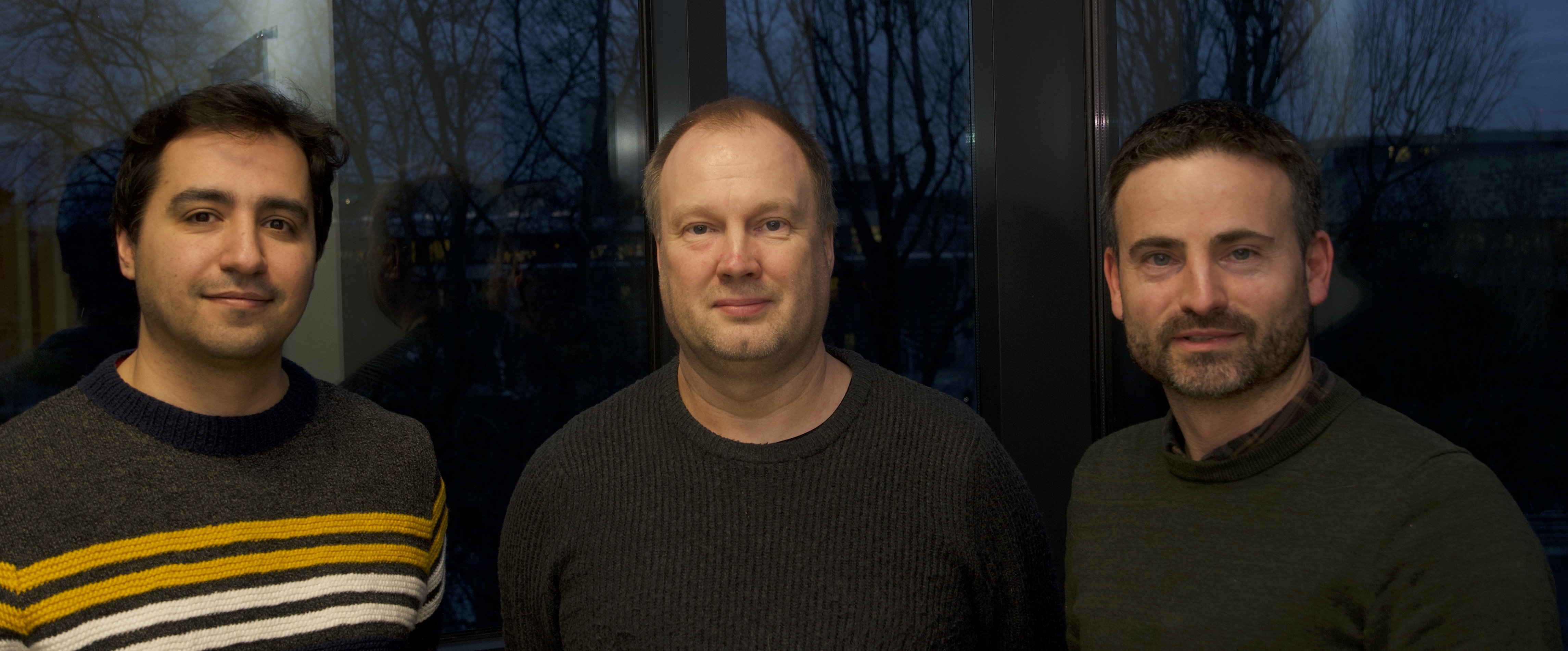
| Dr. Ali Saberi Mehr | Dr. Andrew D. Phillips | Dr. James G. Carton |
| School of Mechanical Engineering – UCD LinkedIn Profile School Profile | School of Chemistry – UCD LinkedIn Profile School Profile | School of Mechanical Engineering – DCU LinkedIn Profile School Profile |
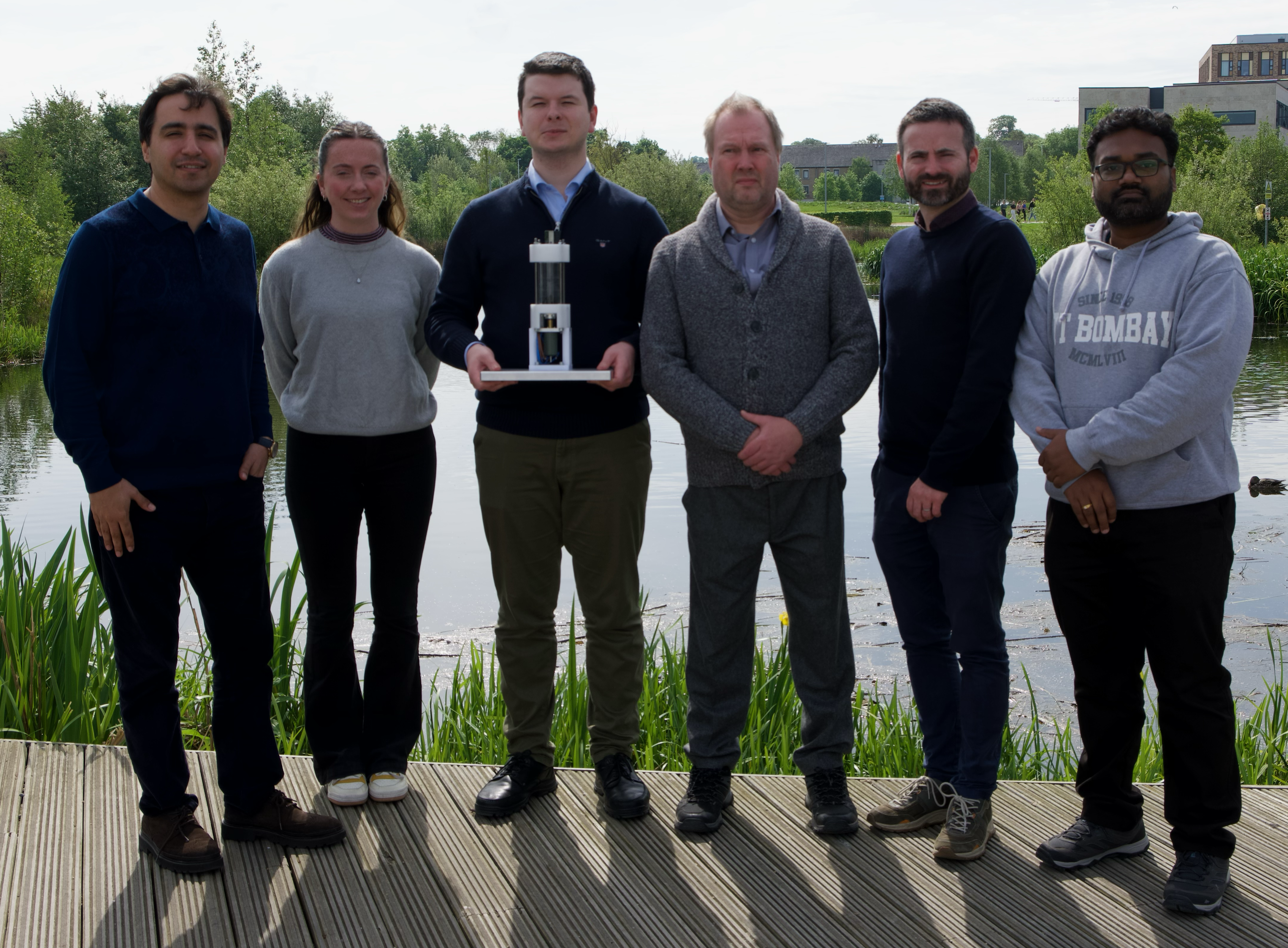
The RESR team – May 2024. Left to Right: Dr Ali Saberi Mehr (UCD), Eva Giblin (UCD), Luke Gilroy (DCU), Dr Andrew Phillips (UCD), James Carton (DCU), Dr Animesh Hajari (UCD).

The RESR team – May 2025. Left to Right: Sepideh Islami (DCU), James Carton (DCU), Dr Andrew Phillips (UCD), Luke Gilroy (DCU), Dr Animesh Hajari (UCD), Dr Ali Saberi Mehr (UCD)
Biographies

Dr. Andrew D. Phillips (UCD, SFI-funded Stokes Lecturer (2008-2012)) is a synthetic inorganic-organometallic chemist with significant skills and experience in homogeneous catalyst design, specifically ones that extract or incorporate hydrogen gas. Dr. Phillips is highly qualified and have extensive knowledge on hydrogen and particular all aspects of its safety. Catalysts discussed in these were developed as a lead PI in the SFI-funded research cluster Solar Energy Conversion. Further optimisation of the catalysts and solvents were performed with a EI grant (CF20122304). Since 2010, Dr Phillips has engaged in a program of research centred around AB dehydrogenation as a clean source of hydrogen, focusing mainly on catalyst design, optimisation and studying the mechanism of operation by collaborations in computational chemistry. His research developed two generations of an extremely fast and robust homogeneous catalyst, both of which are patented (WO/2011/151792 A1, WO/2014/174465 A3) and the several IDFs regarding the design of the prototype reactor. His has 8 publications in international journals regarding ammonia borane and generation of clean hydrogen. Dr. Phillips is the Irish representative of the energy division of the European chemical society (EuChemS).
Dr James Carton is an Assistant Professor in Energy Sustainability in the School of Mechanical and Manufacturing Engineering at Dublin City University and is a member of DCU’s Sustainability Council. Dr Carton is a Funded Investigator in the SFI-backed Research Centre for Marine and Renewable Energy (MaREI) is PI of “HyLIGHT” a Science Foundation Ireland project with MaREI to investigate the role of hydrogen to support decarbonisation on the island of Ireland, and an alumni member of the World Energy Council. Dr Carton is engaged with Hydrogen Ireland Association, Hydrogen Mobility Ireland & Hydrogen Taskforce Expert to the United Nations Economic Commission for Europe (UN-ECE). Dr Carton’s research is focused on the modelling and integration of energy systems, specifically energy storage systems and hydrogen. Dr Carton has had successful funding from Enterprise Ireland through their commercialisation funds (CF20144312, CF20133023, CF20150313), developed and patented (WO/2014/037494 A2) fuel cell and electrolyser materials and technologies that overcome several technical, manufacturing, assembly and scaling issues experienced by existing systems due to a patented multifunctioning architecture. Dr Carton’s research is multi-disciplinary covering knowledge in materials, design, energy device functionality, chemistry and electrical engineering necessary for this project.
Dr. Ali Saberi Mehr is an Assistant Professor in the School of Mechanical. Dr. Saberi Mehr’s research focus is green hydrogen Fuel Cell (SOFC) technology and H2-biofuel utilisation through innovative technology development, including polygeneration concepts, Power-to-X, Power to Gas, and various renewable-based power systems. Parallel to his 4-year teaching experience, he successfully published more than 30 peer-reviewed journal articles as well as EU-funding, and two industry-academia projects as PI. Dr. Mehr was involved in the EU-funded €10 million project “DEMOsofc”, the largest Demo of installing a 174kW-SOFC system in Turin, Italy. Dr. Mehr is currently involved in “HyLight” project, a partnership between three academic institutes (DCU, UCC, and NUIG) and 25 industry companies, funded by Science Foundation Ireland (SFI). His main focus is currently to explore the role of hydrogen in supporting decarbonisation on the Island of Ireland and to provide a meaningful roadmap for large-scale green hydrogen production hydrogen storage technologies, including and various hydrogen delivery scenarios. Dr Mehr will use his mechanical engineering experience to integrate hydrogen storage and fuel cell systems to ensure this project is delivered.
Dr. Animesh Hajari (LinkedIn profile) is a Post-doctoral fellow in the School of Chemistry at University College Dublin. He has completed his PhD on ‘Role of solvents and support material on dehydrogenation and regeneration of Ammonia Borane’ from IIT Bombay. He has authored major publications in international journals (6) on the catalytic dehydrogenation and regeneration of Ammonia Borane using support materials. He is focused on the dehydrogenation of Ammonia Borane using a patented catalyst (UCD) and different solvents, and also the regeneration with optimised yield.
Mr. Luke Gilroy (LinkedIn profile) is a full-time Research Engineer for the RESR Project. He graduated from Dublin City University with a Bachelors and a Masters in Mechanical Engineering, having completed a dissertation on a Life Cycle Analysis of domestic solar panel use in Ireland. Luke’s focus within the RESR team is the development of the reactor and its surrounding systems, including running experiments involving the reactor and continuously iterating on its design. He has a deep interest in bringing awareness of cutting-edge sustainable technologies and practices to a wider audience, and he intends to use this to further benefit the RESR project.
Dr Navid Kousheshi (LinkedIn profile) is a Post-doctoral Fellow in the School of Mechanical and Materials Engineering at University College Dublin. He completed his PhD on the impact of syngas variation on reactivity-controlled compression ignition (RCCI) engines. His major research interests include hydrogen production and multi-generation concepts, advanced CO₂ capture technologies, integration of fuel cell and engine hybrid systems, and thermo-economic and life-cycle analysis of low-carbon energy systems. He is currently applying his expertise to the life-cycle assessment (LCA) of the RESR Ammonia Borane project, as well as to techno-economic modelling of the entire system.
 RESR Ireland